It is Easy to Get Gc After Getting Canadian Pr
Well Done! You have done it. You have passed all the barriers to come across Canada.
Before you learn about settling new things just after landing in Canada as PR.
Are you still rewinding the entire journey from the day one which you have gone through to land in Canada?
Cut the rewinding tape right now!
Yes, you have landed in Canada but the mission is not yet accomplished. Landed in Canada does not mean the journey comes to an end but it is just the beginning of new life where you have to settle yourself down in a completely new environment.
From the very first moment when you landed at any first entry port of Canada with Permanent Residency activation by the immigration officer, your journey starts right from there. Apart from this, there are many important things which you need to follow.
So now the question is, What are the things to do after you land in Canada?
I have tried my best to cover up all the important steps after receiving COPR and explained how to do that including my own experiences as well.
I hope you may find it helpful.
30 Most Important First Things to do After Landing in Canada as Permanent Resident :
Let's proceed towards our first steps list.
1) Activate your Permanent Residency
We all know you receive confirmation of permanent residency (COPR) of Canada but it is not yet activate. I hope you know it but don't get disappointed and tense. It is a normal procedure for everyone.
The letter of COPR and Visa is just the confirmation that you have received the permanent residency but it will be activated when you land at the first port of entry in Canada.
The immigration officer will ask some general queries at the time of landing interview and once he/she is satisfied with the given details and the details you are telling him/her only then the immigration officer will sign and stamp on your confirmation of permanent residency (COPR).
For more details on what the immigration officer asked me at the time of landing :
» Read my: First Landing Experience at a Canadian Airport as Permanent Resident
Congratulations! You are now an official Canadian Permanent Resident. Cheers!!
So, What next after getting Canada PR?
2) Apply for Social Insurance Number (SIN)
The next step is to apply for the Social Insurance Number. Social Insurance Number is a 9 digit unique number given to everyone by the government to access various government benefits and programs.
It is a general practice to protect your SIN number and not to tell anyone unofficially. Only share your SIN number with official matters.
You can apply for SIN on landing airport if you have any temporary address in Canada.
If you don't have any Canadian address yet, then you can also apply to the Service Canada office located at various locations in a particular city. You can visit there without an appointment.
This is a very smooth process. After passport / CoPR documents verification, Officials will provide you a piece of paper on which your Social Insurance Number will be mentioned with some more information.
- For more details check How to Applying for a Social Insurance Number(official website)
Keep it confidential and safe. Save it carefully as you will need this number while applying various government benefits forms, tax filling, health benefits, etc.
3) Apply for Permanent Resident Card
During the landing interview, the immigration officer asks about the permanent address for delivering the permanent resident card.
If you don't have the permanent address at that time, he will give you a form "ADDRESS NOTIFICATION – PERMANENT RESIDENT CARD" where you will find the instructions on how to update the address for a permanent resident card later.
You can call on given PR card call center number or fax the given form at PR card processing center or can access the on-line address notification on the official web site.
- Check here How to Get a permanent resident card (official website)
Once applied or update the address in any way, you will receive your permanent resident card within 6 weeks.
The easiest way to apply for a PR card via call center number, I applied in the same way and received my permanent resident card in 3 weeks.
Make sure your calling time should be the early morning starting hours of office timings, otherwise you have to wait for a long time on call and sometimes call center over-flooded with calls and agents put your call in automated answers.
Note: Don't forget to update your address within 180 days after landing. Otherwise, you have to submit a different application to obtain your permanent resident card and you will be required to pay the application fee.
4) Buy a Local SIM Card
Canada has various mobile networks like any other country, operates nationwide. All service providers offer different calls + text messages + data plans. The major providers are ROGERS, TELUS, KOODO, and BELL.
You can buy a SIM card from your nearest service providers stores or you can buy from amazon.ca here are the best links to buy:
- ROGERS
- TELUS
- KOODO
- BELL
- Virg in
- Lucky Mobile
- Freedom
- Public Mobile
There are individual, students, and family sharing plans available and you can choose according to your need and if you do not like the services of a particular network then you can port your number in any other service provider at any time.
Some providers also offer SIM cards plus Mobile plans in which you can buy a smartphone with a SIM card with 2 years lease agreement by paying a fixed amount each month.
- Find out The: Best Cell Phones Plans in Canada
To buy a SIM card you need to have two pieces of identity like your passport, COPR document, and SIN number.
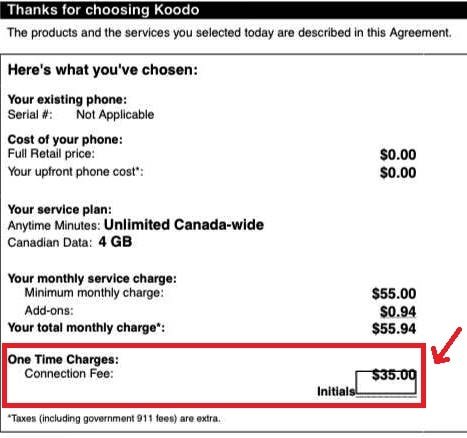
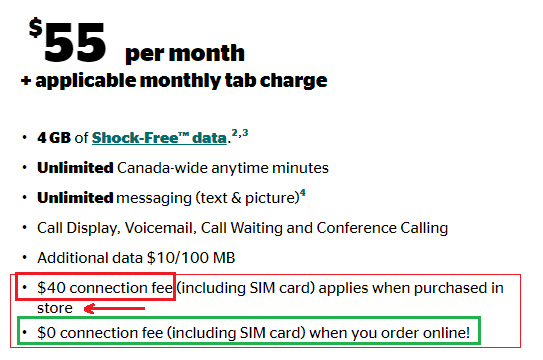
We bought it offline from the Koodo store, they charged us $35 each EXTRA for connection fee (We paid $35+$35 = $70).
I don't want you to lose money. So research well before choosing the network.
Whereas the connection fee is $0 when you order online.
5) Set Up a Bank Account and Apply for Credit Card
Managing finance is a major concern for everyone in any country so is here in Canada.
The major banks all over Canada are TD, RBC, Scotiabank, CIBC, HSBC, BMO, etc.
How to open a bank account in Canada?
To open a bank account in Canada after landing, you will need a COPR document (If you don't have a PR card), SIN number, and a copy of the passport.
You will have to call a bank and book an appointment with them.
Although you can open a bank account from your home country too before coming to Canada, I will suggest you open an account after arriving in Canada so that you can physically visit banks before making the decision.
Research before opening an account as banking is costly here in Canada where you have to pay for a transaction after a certain period.
Some banking institutions give great initial months befits to new immigrants and students so take advantage of that benefits like no transaction fees for the first six months, free reward points, free credits bonus (vary from $100-$500 or more) and no need to maintain a minimum balance in the account, etc.
You may check different bank's 'Newcomers' programs/offers here and then compare them carefully :
 | TD Bank – Newcomers |
 | RBC – Newcomers |
 | Scotiabank – Newcomers |
 | CIBC – Welcome to Canada |
 | HSBC – Newcomers |
 | BMO – Newcomers |
There are two types of bank accounts 'Saving and Chequing'.
You definitely need a chequing account as most of the employer's demands for a direct deposit of salary each month. In some countries, chequing accounts are named as the current account.
A Bank account is necessary to pay your phone bills, utility bills, and any other shopping transactions.
In addition to this, to take advantage of Canadian benefits like child care, low income, etc. you must have a Canadian bank account number.
Apply for a credit card as soon as possible. It is always a good practice to pay your bills before the last date to build a good credit history as credit history helps you to take a loan for your house, car, or to start a business in the future.
If you have some valuable items like jewelry, you can opt for lockers in the bank although it is not mandatory.
6) Apply for Health Card
In Canada, health care is publicly funded. You will get eligible to have the health benefits if you have your health card.
To apply for a health card, you need to visit your provincial service office. You can also apply online by searching on Google.
In some provinces, it takes almost 5 months to cover up your health benefits but in some provinces like Alberta, you will get health benefits right from landing day.
As I mentioned above, health care is publicly funded but yes everything is not free and covered under health care. Most of the province's covered and not-covered list as below:
What is Covered?
- Appointments with your family doctor
- Visits to walk-in clinics
- Visits to an emergency room
- Necessary tests and surgery
What is Not-covered?
- Dental Services
- Prescription Drugs
- Ambulance Services
- Laboratory Test
Every province's health care is different from each other in terms of processing time and services providing.
To apply online, please visit the following links as per your location :
- Alberta
- British Columbia
- Manitoba
- New Brunswick
- Newfoundland and Labrador
- Northwest Territories
- Nova Scotia
- Nunavut
- Ontario
- Prince Edward Island
- Quebec
- Saskatchewan
- Yukon
Once you get your health card in your hand, you will get the list of doctors near your area who are accepting new patients. You can choose your family doctor from the list and your family doctor will prescribe you the medicine according to your health needs.
There are always walk-in clinics in every neighborhood in each province, but it is always a good practice to have a family doctor so that he/she will go through your medical history and current medical situation to provide a more suitable prescription.
In Canada, you will never get some medicines like antibiotics without a prescription. Thus, better to take some general medicines from home countries as health cards can take 3 months to cover general health issues.
Your employer also gives your health benefits as everything is not covered under public-funded health care cards. Some employers also give dental benefits which are very costly in Canada.
7) Find Accommodation
As you are just landed in Canada, you may be living in a place that is not permanent. Some live at their friend's place, some at low-cost hotels, and others prefer AirBnB which is now a day popular and cheaper option than a hotel.
Finding accommodation is a hectic job but various websites and classification make it easy. There are various websites like Kijiji, rent board and many more where you can have a look of the property and compare prices.
Read Here: Top 10 Local House, Flats and Apartments Rentals Sites in Canada
Things to Consider Before Renting :
There are few things which everyone needs to consider before booking of an apartment like:
- Distance from shopping centers, schools, public transport, work location, banks, walk-in clinics, parks
- Availability of Heat, water, electricity, parking
My suggestion is to take an apartment near to settlement agencies for the starting period and after that shift according to your needs or working locations as everyone needs to visit settlement agencies many times in starting days.
Make your budget according to you and select an apartment that includes heat and water. Sometimes the owner can include electricity, internet, and cable connection too with increment in rent.
Apartment or house can be furnished or fully-furnished or un-furnished.
Parking can be and cannot be included in the rent so don't forget to confirm.
Rent agreement can be renewed monthly (some companies has a month to month options) as well as yearly.
Agreements which renew yearly are cheaper than monthly one with the difference of $25 to $50 or more each month varies according to location and company.
Most of the owners and property managers take an advance one month rent as a security deposit which is refundable or adjustable as one month rent.
To book an apartment, you will need your Passport or COPR documents copies and SIN number.
8) Apply for Utility
Utilities such as electricity, heat, and water. As mentioned above, heat and water are included in most of the apartments or house but very fewer houses and apartment gives the provision of electricity included in rent.
When you rented an apartment that is managed by some rental companies, you will need to apply for the utility of electricity by calling or visiting your nearest government utility provider's office.
How to apply for Utility?
To apply for a utility, you will need to have the name of utility holders like you and your spouse/partner, SIN number, Rental agreement, and COPR document.
They will transfer the electricity connection to your name which is pre-installed in the property.
There will be a one-time activation fee which you need to pay and for the rest of the month, you will just need to pay the consumed electricity.
Please keep your utility bill carefully every month as this is useful as a proof of your resident in Canada.
Choose your province and check the details:
- Alberta –Energy Alberta
- British Columbia –BC Hydro
- New Brunswick –NB Power
- Nova Scotia –Nova Scotia Power
- Newfoundland –Newfoundland & Labrador Hydro
- Northwest Territories –Power Corporation
- Manitoba –Manitoba Hydro
- Ontario: has different options, which includes Hydro One andToronto Hydro
- Prince Edward Island –Maritime Electric
- Quebec –Hydro Quebec
- Saskatchewan – SaskPower
9) Take a break, Relax and Explore your city
Congratulations! You have done very well till now and all set up for the initial after landing formalities.
You are in your dream country and yes you are Canadian permanent resident now. Feel the fresh air and enjoy these moments.
Take a break for some days, after all, you are gone through a very big, long and hectic process and successfully achieved your dreams.
Sleep well! Get rid of Jet lag. Do whatever you were dreaming to do after arriving in Canada.
Explore your city and province.
Start roaming around.
Go for a walk, meet people, make friends, and just live every moment.
Before starting a new life in Canada, get refreshed.
Read local newspapers, go out to shop your grocery items.
Analyze things and compare them with your home country.
Learn the rules and regulations of Canada.
Don't hold yourself in your apartment if it's COLD out there. Just get up, and go out and get positive vibes before starting your new journey.
Above all, enjoy a few day's holidays!
10) Apply for Child Care Benefit (CCB)
Canadian government gives benefits to parents who have a child or children under the age of 18 for a better upbringing of your child.
As a permanent resident, you are eligible to apply for Canada child care benefits. The Canadian government will give you child benefits each month, mostly received 20th of every month.
The Canadian government considers the mother as a primarily responsible person for the upbringing of a child. Hence, if you are a couple and living in one house, a mother will be considered as a primarily responsible person and she should be the one applying for Canada child care benefit.
How to apply Child Care Benefit (CCB)?
Anyone can apply online as well as via mail by sending filled forms on the given address.
After applying you should receive your first payment:
- Within 8 weeks when you apply online.
- Within 11 weeks when you apply by mail.
If you still have any questions on how to apply, visit your nearest settlement agencies, they will help you to apply.
As Canada Child Benefit (CCB) is administered by the Canada Revenue Agency (CRA) so you have to declare your family income for the last three years whether it is Canada or your home country in the child care benefit form. Oh, and yes, Canada's child benefit (CCB) is a completely tax-free benefit.
To keep getting your Canada child benefit (CCB), you must file your tax return on time every year. If you have a spouse or common-law partner, they also have to file their tax return on time every year.
You must file your tax return even if your income is tax-exempt or you have no income. If you don't file your tax return every year, your payments of child care benefits will stop.
The amount paid as child care depends upon the total net income of a family. The maximum CCB by the government given to them whose family's net income is under $31,120 and whose child is under 6 years of age. Take a look below:
For each child benefit amount you will get according to this :
- Under 6 years of age: $6,639 per year ($553.25 per month); If your family income less than $31,120
- 6 to 17 years of age: $5,602 per year ($466.83 per month); If your family income less than $31,120
Please visit the link to calculate your CCB according to your family net income:
- Calculate on official website : How Much You Can Get – Child Care Benefit
11) Visit Settlement Organizations
Leaving your home country and starting a new life in any other country can be very tough, especially when you do not know the culture, traditions, and laws in a new country.
Settlement agencies in Canada are those who help newcomers or immigrants or refugees to settle down things in Canada. Settlement agencies provide information and most of the services are free to use which help you and adjust your life according to Canadian culture.
Every settlement agency is funded by the Canadian government. A settlement counselor in a particular organization will help you with your specific settlement needs.
The various services provided by different organizations can vary but most of the organization provides the following services:
- Helps to settle down your day to day life
- Fill out any kinds of forms
- Learn about community services
- Assistance applying for a Health card
- Tax filling Assistance
- Child Tax Benefits Assistance for Applying
- Helps to learn English
- Offers various employment services
- Helps in finding a job
- Helps in making Canadian resume and cover letter
- Services for Women, Youth, Refugee, Seniors
- Shopping information (food, clothing, and more)
- Information on housing and education
- Sign up your kids for school or university
- Helps signup for low budget housing
- Health and recreation information
- Information on getting a Drivers Licence or SIN
- Referrals to other community programs and resources
As mentioned above, several organizations all over Canada that help newcomers and you can check the name and address of organizations on the Canadian government official website.
- Here on the official website you can: Find free newcomer services near you
My Experiences with various settlement services :
Saskatoon Open Door Society :
As I am living in Saskatoon, I visited Saskatoon Open Door Society in my initial days which I found very helpful in many ways.
My settlement counselor "Faiza Nasr" helped me to sign up for Canada child care benefits, apply for a health card, and provided much more information regarding settle down in Canadian culture.
Thank you, Faiza!
Faiza refers me to Saskatoon open door society's employment services. These people are providing extra-ordinary sources to help newcomers or immigrants on how to find a job in Canada.
Saskatoon Open Door Society – Employment Service Unit
The Employment service unit suggested I should take some programs which will for sure help me to find a job in Canada and will be free of cost.
I have joined 6 weeks program under employment service unit and my employment counselor "Raphael Pinto" is helping me in various course lines like how to make a targeted resume, cover letter, how to prepare for an interview by practicing me via mock interviews, telling me various sources where I can find my career-related jobs.
I appreciate Raphael who is delicately helping me and my 9 other classmates in making and finding their routes which directly leads to success.
Thank you, Raphael!
International Women of Saskatoon (IWS)
I also visited International Women of Saskatoon (IWS) which is also a settlement agency dedicated to women in most of the settlement programs.
I Met "Shaban Liban" as my settlement adviser. I appreciate his help which he provided me in our 3 or 4 meetings and I am following his guidelines to find a job from various sources.
Thank you, Shaban! For patiently handing my every call as I used to call you many times to have the various settlement details.
Global Gathering Place (GGP)
Another amazing settlement agency I have visited is the Global Gathering Place in Saskatoon.
My counselor "Sana Khan" helped me to understand various programs that GGP is running to help newcomers in Saskatoon. I liked the way GGP publishes every month's plan calendar which includes various programs and activities each month.
Thank you, Sana!
The one program called "Coffee and Conversations" which held on every Thursday between 1-4 p.m. has attracted me more as this program concentrates on general conversations between newcomers and local Canadian people.
This is an amazing program to know new people and build connections in my new home town.
12) Apply for Driving License
To legally drive a car in Canada, you'll need a driver's license issued by the government of your province or territory. You must have it with you whenever you're driving. With a driving license issued by any province or territory, you can drive anywhere in Canada.
Driving in Canada is different than any other country as Canada drives on the right-hand side unlike India drives on the left-hand side. Rules of driving are more strict over here which everyone has to follow strictly otherwise there will be a case of a large number of tickets, penalties, demerit points, and vehicle impoundment.
Apply for a driving license as soon as possible as you will need to go here and there for many reasons. Although there are other mediums of transport available in each city having your vehicle gives you more freedom and convenience especially during extremely cold weather.
You can drive on an international driving license up to a certain period like in Saskatchewan; you can drive up to 3 months if you have a valid international driving license.
Don't forget to convert your license in English if it is in any other language.
How to apply for a driving license in Canada?
To apply for a license, you need to give a vision test and a written test which includes one test of basic driving rules and one traffic symbols exam.
After you pass the written exam, you can book the road test at the same time. After you have passed the road test, the Canadian driving license will be issued to you.
Practice online more and more before giving a written exam just to save your money by directly going to give test without any practice and knowledge of rules and types of questions.
Check this helpful website to practice online: Driving Test Written Knowledge – Learner's Permit
To give a written test, visit your nearest driving test center.
Documents required :
- SIN number
- (2 piece of ID proof) PR card or COPR document and Passport
- (2 piece of Residential proof) Lease agreement or Bank account statement and Your Utility Bill.
After you have passed a written exam, the officer will see your driving license from your home country. Based on that license officer will tell you that whether you need to take driving classes or not before booking a road test.
If the officer noticed that you have enough experience in your home country or have a very old license (according to the issued year), he/she can direct you to book a road test straight away.
If you do not have a license from your home country or you never drive a car, the officer will give you the direction of attending classes for a certain period to get a learner license.
This is my serious recommendation to have a good command of driving before giving a road test.
Otherwise, if instructors noticed the dangerous driving while taking a road test, you will be directed to take classes right away.
Without taking classes and having a certificate in the hand of classes attended, you can not give a road test at all. This same rule applies to all the provinces.
Various provinces have given a different name to the same types of licenses. Like in Saskatchewan, a learner driving license is called Class 7, an experienced driving license is called Class 5, so on and in Ontario, for new drivers, it is called "Level One and Class G1 license".
To apply for a license according to your province, Check the links below:
- Alberta
- British Columbia
- Manitoba
- New Brunswick
- Newfoundland and Labrador
- Northwest Territories
- Nova Scotia
- Nunavut
- Ontario
- Prince Edward Island
- Quebec
- Saskatchewan
- Yukon
No Need to give Written or Road Test 'IF'
If you have a valid driver's license from any of the following countries and it is more than 5 years old, you can apply for a Canadian driver's license at any motor license issuer; yes you read it right you do not need to give any written and road test:
- Another Canadian jurisdiction
- The United Kingdom
- The United States
- Australia
- Austria
- Belgium
- France
- Germany
- Republic of Ireland
- South Korea
- Switzerland
- Taiwan
- Japan
- Jersey
- Netherlands
- New Zealand
13) Get Wi-Fi Connection
The mobile data plans give you very limited data to use every month which hardly suitable for mobiles only. Although it is not very much necessary I found it very important for me and my husband as we are IT persons and we cannot survive without the internet and more data. 😛
TIP : I had my amazon fire stick with me which I brought from my home country, I can enjoy any movies and news and serial with just connecting it to the internet. You don't need to spend more on smart TV because every $ counts. So its better to get a Non-smart TV and get Amazon Fire Stick from amazon India, if you are in Canada you can get it from here. This is how we entertain here.
This is the best time pass for my kid too as he likes to watch 'Peppa Pig', 'Thomas Toy Train' 'Blippi' on Youtube.
Various companies provide different internet plans.
Have a look at the major services providers :
- Bell
- Shaw
- Rogers
- Telus
Keep in mind; do check with your property manager or owner of an apartment or house before applying for Wi-Fi connection as some owners provide internet connection within the rent amount.
14) Transit Card
Being a newcomer in any country leads to mess with transportation as we are assuming not having a car with us in initial days or sometimes later on too.
Traveling in a bus or local transit can reduce your cost from a cab and also reduce your traveling time in case of big cities like Toronto.
Apply for a local transit card from a local transit office. Transit pass can be made according to the number of rides you need per month with less cost or for a full month with standard cost and have unlimited rides per month.
The Canadian transit system is very good and there is no hustle in catching a bus in any city. You just need to have the number of a bus that is going to take you to a particular destination.
To know the bus route, you can just download the bus route from the official website or you can also download the app on the phone which will accurately let you know the bus route, timings, and bus number.
15) Visit Employment Agencies
Job is the pre-necessity for everyone to survive in any country. As a newcomer in Canada, never expect that you are gonna take your dream job as soon as you landed in Canada unless you are lucky to have a job in your stream right after landing.
Most of the newcomers do survival jobs just to support their normal livelihood at starting or until they find a job in their field.
Talking about me, it has been months when I landed in Canada and still looking for my first job and this is the reason that I am spending my most of the time to write articles from my deep research and experience for you people who want to know what to do after landing in Canada.
Many websites help you to find out the jobs in your city like Indeed, Glassdoor, Google jobs, and many more.
In addition to this, you must visit local employment agencies. It can be government-funded or non-profit organizations or private agencies.
Talking about non-profit organizations, as I mentioned above my experience with Saskatoon Open Door Society-Employment Service Unit is very good.
Raphael Pinto, my employment counselor, helping me a lot on how to find and apply for a particular job that is related to my field. Despite this, these people also give moral support to all newcomers who are struggling to achieve their first job in a new country.
Apart from this, I also went to a private employment agency called "Express Employment Professionals" and met with an outstanding lady employment counselor "Darlene Cooper".
She let me know that I am not alone who is sailing in this boat and she is struggling a lot to cover this gap between newcomers and finding their field job.
I must say, Darlene! You are an amazing person and thanks for being there for me and everyone like me.
Search on Google about your city's employment agencies and have a visit and get registered with them so that they can help you in finding a job.
16) Start Preparing for Job Interview
Everyone can crack the interview all we need is to polish the skills specifically for Canadian interviews. Search online on how to make Canadian style resume and cover letter.
Search how to make a target resume by describing the job duties according to the keys responsibilities mentioned in job postings.
Never do the mistake of sending a general resume to employers as I did. Make a different resume for every job according to the mentioned responsibilities.
Watch videos online, train yourself by practicing in front of friends, family, and mirror.
In addition to this, you can join the program in any non-profit organization on how to make Canadian style resume, cover letter, and how to prepare for an interview. They people will help you practicing by taking mock interviews like you are giving an interview in an actual environment.
17) Join Mentor-ship Programs
Some government-funded agencies or newcomer centers run mentor-ship programs which help to settle the newcomers in their field of work and some as an entry-level position.
Agencies run mentorship programs several times in a year so it is good practice to put yourself in the waiting list even if you did not succeed in getting a seat at once.
Visit every settlement agency near you and ask about their programs and register yourself under every program which is offering work placement after in-class training even though work placement is not paid at starting.
At least you are gaining Canadian experience to mention in your resume and if everything works well then the employer can hire you in the future.
Search on Google about the mentorship program in your province and you will get the details according to your location.
18) How to Buy a Car in Canada? + Car Insurance + Winter Tires + Baby Car Seat
After landing in Canada, Car is as important as renting an apartment.
Some people prefer using public transport which is fine for initial days, but you really need a car to start your daily life here.
Buying a car is not a big hassle here in Canada, but it can be a BIG HASSLE if you buy the wrong car. Repair costs are so expensive here and especially when you are starting a new life.
Do your proper research before finalizing the deal of your first Car.
Make your mind which type of car would you like to buy, Sedan / SUV / Crossover, etc.
Decide your budget because as a new immigrant every $ counts.
Start your search from Kijiji or Facebook Market place. I would personally suggest you buy directly from the owner because you might save a lot of money. After all, I felt that buying from any authorized dealer is always costly than buying directly from the owner (But only if you get all the right information mentioned below).
Well, whether you are buying from the owner or dealers, make sure you go through all the necessary and important information about the car history.
Check car's history through Car's VIN – Vehicle Identification Number (To check car's collisions / Theft reports).
- Search Vehicles by VIN here
- Cross-Canada VIN search
Check Car's inspection reports.
Ask for LIEN details (LIEN is LOAN/DEBT stands on the car)
It would be great if the car owner has a CarFAX report. (OR you can personally get the CarFAX report because it's better to spend a few bucks before spending in thousands) Where you can check who were the previous owners of the Car and in which province it was first bought and in which provinces it was driven earlier.
Check: Canadian Vehicle History Reports | CARFAX Canada
Winter Tires
Another important thing to consider when buying a pre-owned or new car is winter tires. The reason is 'snow' on the roads.
In many provinces where it's snowing all the winters. You will need to buy a good set of winter tires. When you are buying a car, ask for winter tires most of the owners already have them installed.
Otherwise, you may consider it buying on your own.
Although it's not mandatory in most of the provinces all the provincial transportation authorities strongly recommend buying winter tires.
Do check "winter tire law" in your province.
If you are not in a hurry buying your first car, well there is another option available.
Another option is Rent-A-Car for your initial days.
Check here: Rental Cars at Low, Affordable Rates
Cost varies according to car/vehicle you choose, location, days, etc. Price starts from as low as $21/per day or less.
Car Insurance
Having a car and a valid driving license is not enough to drive a car in Canada, you must have car insurance before driving a car and it is illegal to drive a car with car insurance. You will need to pay every month for car insurance.
There are different types of car insurance available according to a different province and different coverage which you can check on the above-mentioned links or by directly visiting the authorized government offices.
The cost of your car insurance depends upon the plan (Monthly/Yearly) you choose according to coverage and following factors:
- age
- driving record
- living location
- driving experience
You can opt for monthly or yearly or half-yearly payment for your insurance.
Baby Car Seat
If you have a baby. You must buy a baby car seat which is mandatory all over Canada. Here in Canada, even you have to take your baby from hospital to home you would need Infant / Baby car seat installed in your car.
I have researched a lot about the best affordable baby car seat for kids and found Safety 1st Alpha (Check here) was the best selling and affordable option on amazon. Solid build, comfortable seating, overall It was the best choice and was really easy to install.
19) Apply for Identity Card of your Province
An Identity card is very much important for all the official work here. You would require 2 pieces of IDs for most of the registrations/bank openings/buying a car/for a driving test. You would need to take COPR and Passport along with you all the time until you won't receive your PR cards or you won't get your driving license.
After getting accommodation, apply for your ID card from your province so that you won't pick your passport all the time.
20) Flu Shots
Flu shots are also known as Influenza vaccines. The flu shots make your immunity system strong and protect your body from getting infected by Influenza Viruses.
The Canadian government recommends all the Canadian residents to get free Flu shots during the flu seasons which occur mostly during fall, winter, and early spring.
You might consider it getting or not that depends on you. I myself and my family didn't get flu shots yet.
By the way, it's available FREE and you can get it from any pharmacy/doctors or nurse practitioner/public walk-in clinics.
21) Register your Child to School or Day Cares
Schooling is completely free of cost here in Canada starts from Kindergarten and continues grade 1 up to grade 12.
The School session starts from September to June. July and August are the summer holidays. So if your child is a school kid you should consider planning your landing month according to that.
You urgently need to register your child's name on the school list as soon as possible because the waiting period might be too long for a specific school, especially for daycares.
You can get more details according to your city from your nearest settlement agencies/newcomers' information centers.
There are different types of School / Daycares in Canada. Two major schools are Catholic schools and Public schools.
Here are the children age categories according to the Canadian education system :
Kindergarten: Children should of 5 years to enter the school's Kindergarten
Primary / Elementary School: After Kindergarten, they enter in primary/elementary school from grade 1 to grade 7/8, depending on the school/province.
Secondary /High School: Starts from grade 8 or 9 To grade 12. Some school in some cities have a junior high school level which lies between elementary school and high school
Daycares/early learning age group is 6 weeks up to 5 years and all the daycares are paid for sure. Fees may vary according to your location according / child age group etc.
There are two types of Daycares:
- Licensed
- Un-Licensed
Visit your provincial government website to find a licensed daycares list and start your search.
Important: If your family income is low, The Canadian government helps you to pay your child care subsidy. For that, you will have to find a subsidized daycare list from your province government site. A subsidy may vary every month according to your income.
22) Networking, But How?
As a newcomer in Canada, it is obvious that we do not know anyone here. Some people have friends here in Canada but most of the people like me do not have any friends here.
Networking is important here in terms of making new connections and more importantly making references in Canada.
References are important while applying for any job in Canada as every employer needs someone in the same company who can ensure new employees.
Networking can be
- Un-professional
- Professional
Un-professional networking leads to making new friends nearby, visit community centers and meet people from the same nations.
Start talking to strangers in your building, search local events on Facebook or Google, and join the events. Do not feel shy while talking to anyone here because people in Canada are very helpful, calm, and talkative. Join local groups and pages on Facebook to get updates on your city and events nearby.
On the other hand, professional networking means making new connections related to your profession.
LinkedIn is the perfect example of making new professional connections especially related to your field or related to a specific organization.
I attended a session on networking given by "Dolores Wollbaum" an employment specialist in Saskatoon open door society-employment service unit. Dolores taught us the importance and tact of networking in Canada. She let us know about the importance of LinkedIn in Canada.
In Canada, when you apply for any jobs online, most of the employers ask you to fill the LinkedIn profile link. Hence, it is a good practice to update your professional LinkedIn profile regularly.
Dolores also taught us the way of networking by writing the name of every single person on paper you know in Canada even though they are your pharmacists and start connecting with every person whose name you have written on paper.
I implemented this strategy on the same day and send a connection invitation to the same person who taught us the same. Yes, Dolores itself.
Thank you, Dolores!
23) Start Volunteering [Important]
Help is two-way roads if you help someone, someone will help you. Canada is a country where volunteering is more valuable than doing a job. Volunteering is something that you can start anytime and in any stream.
Register yourself under various organizations for volunteering and start helping others. One other benefit of volunteering is making connections. As I mentioned above, networking is very important in Canada. Go out and do volunteering to make connections and references.
Some non-profit organizations or government-funded organizations also gives the provision of volunteering office administrations/clerk and much more other designations. Hence, volunteering is the best way to gain experience in Canadian work culture which will give a boom to your resume.
I started assisting Carlie Russell (Program Facilitator) with one more volunteer William Lian in computer level 2 classes.
As being an IT person, I love to help newcomers who want to learn basic computers which eventually help them to achieve their goals.
I would like to thank Carlie Russell and Erika Thogersen (Volunteer/Program Facilitator) who gave me a chance to volunteer in such a great organization.
24) Furniture Bank Canada
You just landed here and starting a new life. Looking for household items? Start your search from furniture bank Canada. You will find pretty good quality FREE furniture there.
You can get information from your nearby Welcome immigration service center.
#1: Find your nearby 'Furniture Bank in Canada'
#2: Get yourself registered with them.
#3: You would need two pieces of IDs, Copy of COPR and Passport.
It might take some time to get your appointment confirmed and you will get only ONE appointment, you can't postpone it otherwise it will take a while to get another one.
Once you make it as per your appointment. You will get fixed time to choose/decide the furniture you want or maximum you may get 1 hour to figure out.
But you will be allowed to choose a limited number of items only from there.
You won't be paying for the furniture because most of the items are donated by people. You will just have to pay for the shipping cost.
Check the Furniture Bank Website for more details.
Find a Furniture Bank Near You Here.
25) Search House Hold Items on Kijiji
Just in case you are not getting a furniture bank appointment or furniture bank is not available in your city. You can still find many good deals on Kijiji or Facebook marketplace.
If you are lucky you will find many good FREE options available there as well. People are generous here they sometimes post free items to be picked up as soon as possible.
Make sure items are bug/smoke/pet free before considering buying used items/free items. (I would suggest you buy brand new mattress/blankets).
26) Offline Google Map
Download offline Google maps in your phone to save your data while using maps all day in the initial days.
Data is very costly here and you will need to use google maps all the time when you are stepping out. So it's better you can download offline google maps in your phone right after landing.
Follow these simple steps to download offline google maps.
Check here: Google Maps Help
27) Library Card
Apply for a library card as libraries provide various facilities free of cost and some facilities at very less cost like printing a paper/photocopies.
28) Language Assessment
Take a language assessment test if your IELTS is expired as most of the employment agencies demands a valid CLB level from candidates.
Although you are a good English speaker as English is not the first language for most of the people so it is always good to practice English more and more for better fluency and accent.
29) Emergency Contacts
Save emergency contact numbers in your phone like local police station number, Ambulance, or other emergency numbers.
Beware of any scammers/fraudsters. They are everywhere in the world.
Do not trust anyone blindly.
30) Shopping Membership Cards
Make Costco or Walmart or Real Canadian Superstore membership cards for good deals and promotional offers on grocery and many other sections. You are going to save extra money when you will get a master card. Just do some research according to your city/area and grab the best offers.
Conclusion
To sum up all the details, I would like to say 'All the Best' for every single person who landed in Canada as a permanent resident.
I know the starting of everything is hard but soon it will pass and life will come on track after an initial struggle. After all, we all have come across from this struggle of getting permanent residency in Canada and after reaching here the initial struggle is nothing in front of that which we all had faced in the past.
I hope I have covered everything about 'important things to do after landing in Canada' but as I am also in my initial struggling period here, I may miss some of the other things which I will face in the future but I promise you guys to keep updated by posting my new blogs.
Experts, please correct me if I have left anything or any correction required.
Please leave your valuable comments if you have learned something new from this article.
Ah! Don't forget to visit Tim Horton's very often. It makes you feel that nothing is important than Tim Horton's coffee in Canada, not even a job. 😛 Jokes apart.
If you find it helpful please do share it and post your suggestions in the comments. It will inspire me to write more about my experiences in Canada with details.
Friendly Affiliate disclosure : This article may contains some amazon affiliate links You will not be charged anything extra for your purchases by using my amazon affiliate links. I may earn a little commission. it will support me to maintain the website expenses.
Please follow and like us:
Source: https://www.mappledreams.com/things-to-do-after-landing-in-canada-as-pr/
0 Response to "It is Easy to Get Gc After Getting Canadian Pr"
Post a Comment